
June 2026 Newsletter
A monthly round-up of topics, events, tips, and research
Haere mai and croeso!
Welcome back to Mahi Hauora!
Winter is well and truly making its presence felt around Aotearoa, with lots of rain and cold snaps; at my whare | home, the lawns are littered with fallen leaves and the firewood is taking a hammering!
Today, the Education and Workforce Select Committee presented its report on the Health and Safety at Work Amendment Bill; all eyes - or, at least, the eyes of those of us interested in the topic - will be on this report. But, news-wise, this isn’t the only game in town!
This month has a plethora of headlines, events, resources, and research; if you have feedback, comments, or thoughts on any of it, please do let me know in the comments.
Thanks for reading and engaging and take care out there!
This month:
News
June is Pride Month, an annual event inspired by the 1964 Stonewall Riots that seeks to raise awareness of and understanding about LGBTQIA+ communities.
Pride Month commemorates years of struggle for civil rights and the ongoing pursuit of equal justice under the law for the lesbian, gay, bisexual, transgender, and queer community, as well as the accomplishments of LGBTQ individuals.1
In the context of workplace health, safety, and well-being, Pride Month is an important event for supporting diversity, equity, and inclusion and - by extension - psychosocial health and safety.
In addition, despite an increase in the number of people identifying as LGBTQIA+, the Great Place to Work(R) Institute highlights specific issues for these workers, including that they:
have poorer psychological safety
“are 7% less likely to have a psychologically and emotionally healthy work environment”; and
are more likely to experience depression and/or anxiety.
See also:
Relatedly, Te Uru Tāngata Centre for Workplace Inclusion has released its Workplace Inclusion Barometer: Snapshot Report November 2025 - March 2026.
Overall, the Workplace Inclusion Barometer shows a moderately inclusive national environment with strong interpersonal inclusion. To lift the Barometer further, focus should turn to structural equity, including transparent career pathways, leadership accountability, and improving outcomes for marginalised employees.
The snapshot highlights that:
while workers generally feel their leaders support inclusion, roughly a quarter of respondents are not sure whether their employer is committed to inclusion at work
most respondents report positive observations of team climates; and
specific groups (that is, wāhine, Māori, Pacific Peoples, younger workers, disabled employees, and those with overlapping identities) report worse experiences of workplace inclusion.
As I noted in the intro, Parliament’s Education and Workforce Select Committee has released its final report on the Health and Safety at Work Amendment Bill [you can expect to see more from Mahi Hauora on this report soon!].
Announced today, the New Zealand Institute of Safety Management (NZISM) is working with Stand with Pike campaigners Sonya Rockhouse and Anna Osborne on a new campaign. This important mahi seeks “to stop the Government pressing ahead with law changes that make workplaces more dangerous”
See also: Last ditch effort launched to stop health and safety changes
In the lead-up to the latest budget from the government in Aotearoa, the coalition announced it would be looking to cut 8,700 roles over three years. The well-trodden argument is that the size of the public service has ‘ballooned’ to 1.2% of the population, at a significant financial cost. The current government is aiming to reduce this to 1%, looking to AI and departmental mergers to lead this change.
If this all sounds familiar, it’s because reducing the public service is a key attack line (or, if you support it, financially prudent response) for this government. Starting in late 2023, thousands of workers - including me - have lost their jobs.
Regular readers will understand the risks such approaches pose for workers’ health and safety. Job insecurity is a key psychosocial hazard, and recent work from Umbrella + Geneva Wellbeing highlights poor change management as the most prevalent psychosocial challenge for workers.
Keeping Well During Change

Like the proverbial death and taxes, change is an inevitable part of everyone’s work. Recent years have seen the introduction of many changes to our work, occurring at an almost exponential rate. These changes have the potential to have a significant effect on our health, safety, and well-being. But, there are several steps workplaces can take to keep w…
See also:
This week (15-21 June) is Men’s Health Week, an annual event that seeks to raise awareness about men’s health issues and encourage tane to take action.
A boy born today will live nearly four years less than a girl born in the room next door. He will be over 20% more likely to die of a heart attack than the girl, and almost 30% more likely to get diabetes. Worse, he is three times more likely to die by suicide or in a motor car crash.2
The event’s website has some key tools for workplaces and individuals to access:
What’s your score? (An online quiz for men to take)
Information on different conditions that commonly affect men’s health.
Resources on men’s health and Men’s Health Week.
News and feature articles to support men’s health.
In recent months, there’ve been a couple of reports looking at workers’ happiness.
Using research from the London School of Economics, Reward Gateway released The Happiness Dividend. Their report highlighted the benefits of investing in workers’ happiness, suggesting:
happy workers are 10-12% more productive and are 30% less likely to leave their role in the next year; and
improving workers’ happiness can lift business profitability by 21% and increase the value of a business by 20%.
Meanwhile, the Global Happiness Report 2026 from The Happiness Index presented findings from a survey of more than 80,000 workers across the globe. Providing an in-depth analysis, their results include the findings that:
inspiration and belonging are the strongest predictors of happiness at work (while workload management and role clarity are the lowest)
work location has a significant effect on happiness, with “remote and workers [outscoring] office and field-based workers on nearly every dimension”3
happiness at work increases with age and, in nearly every dimension measured, male workers out-ranked their female counterparts
those in middle management roles are happier and more engaged than those they report to and workers who report to them; and
after five years with the same employer, workers’ happiness plateaus.
Parliament’s Education and Workforce Select Committee undertook its annual review of WorkSafe. The accompanying report highlights some questions and concerns raised by the committee. These included (but were not limited to):
concerns around the lack of evidence supporting a change in WorkSafe’s focus leading to a reduction in work-related injuries and/or deaths [this was addressed by referencing work done for the Health and Safety at Work Amendment Bill]
why WorkSafe does not follow Australia’s suit by having a ratio of inspectors to businesses; the answer was a lack of support for this approach by the ILO, and operational differences making international comparisons difficult
how businesses will be held accountable under codes of practice [which have been signalled as a priority by the relevant Minister]; while such codes are enforceable, “inspectors would be looking for businesses not meeting a general duty”4
the report highlighted the committee’s interest in measuring the efficacy of codes in the future
how WorkSafe is monitoring progress and the effectiveness of recent changes; the regulator cited the importance of feedback from businesses
committee members noted “because businesses self-select whether to provide feedback, this may skew the results”5
concerns around less emphasis on targets related to harm reduction; WorkSafe responded that it is more interested in trends (due to ethical issues associated with a specific target number) and that it is only one component of a wider regulatory system
how WorkSafe is working with educational institutions; the response was that the organisation isn’t doing mahi in this space
the morale of staff following a series of restructures and changes; WorkSafe didn’t answer the question, instead pointing to low turnover and nine per cent increase in engagement with workforce surveys
the gender pay gap within WorkSafe (which is higher than comparable public agencies); “WorkSafe noted it currently has more men in senior inspector roles and is looking at longer-term workforce development as part of its employment strategy”6; and
information on the trends related to mental health at work; WorkSafe noted this is a low-priority focus.
We asked about any observed trends in work-related stress or burnout, and whether it works on mental health matters in addition to physical. WorkSafe provided data that had been voluntarily reported to it, but explained that due to funding constraints it has to prioritise physical health.7
As ever, Artificial Intelligence and its effects on the world of work (and, by extension, workers’ health, safety, and well-being) has featured in various headlines of late.
In the US, there appears to be a growing backlash against AI, with speakers and commentators facing boos and growing hostility.
Work undertaken by Microsoft suggests that how well AI is being adopted within workplaces is determined by organisational or cultural factors.
While it’s indirectly related to workplace health and safety, the United Nations recently released a report into the environmental footprint of AI, noting that “every kilowatt-hour used by AI carries carbon, water, and land implications”.8
As I referenced above, the government has indicated a desire to leverage AI to facilitate cuts in public sector staffing levels. However, there are concerns that Aotearoa simply isn’t ready for an AI revolution at work.
According to The IPSOS AI Monitor 2026:
Most workers (62% of 23,532 participants) from 32 countries suggest AI tools have saved them time at work; this is more prevalent among high-income workers and younger (Gen Z and Millennials) workers.
In Aotearoa, this figure was 57% (of approximately 1,000 workers).
A significant proportion of workers (i.e., more than one-third) “are concerned that AI will replace their job in the next five years.”9
In Aotearoa, 56% indicated it was “likely” the way they do their mahi would change as a result of AI, while 23% indicated it was “likely” their job would be replaced by AI in the next five years.
See also:
Relatedly, the Institution of Occupational Safety and Health (IOSH) has published a white paper challenging businesses to ensure that technological developments or progress do not come at the expense of workers.
Businesses are racing to adopt new technologies, yet many fail to consider the psychosocial risks, mental health impacts and ethical implications of these changes. Algorithmic management, digital surveillance and technology fatigue are emerging challenges that demand urgent attention. Without person-centred approaches, robust governance and inclusive practices, workplaces risk becoming technologically advanced but fundamentally unsafe and unhealthy for the people who power them.10
In the paper, the authors argue and/or find the following:
The relentless pace of technological change often fails to account for ethics and/or health and safety considerations.
Engagement with businesses around the world identified cyber security and data protection as the main challenge for implementation of technologies, but “ethical and responsible use of technology features lower”.
Businesses in developing nations are more likely to be concerned with technology’s effects on workers’ health and safety than those in high-income countries.
For remote workers, businesses prioritise the challenges of tracking workers’ productivity and maintaining data security; the health, safety, and well-being of remote workers is a much lower concern.
While improving workers’ digital skills is consistently identified as important for businesses, the driver is profit and productivity, rather than workers’ health and well-being.
Despite the importance placed on up-skilling, 59% of the 1,059 businesses surveyed did not provide safety training and education to support roll-out of a new technology.
All stakeholders have a role to play in balancing the business-related concerns of new technologies with ethics and health and safety considerations:
Governments and policy-makers need to develop clear standards and embed principles in legislation.
Businesses need to embed health, safety, and well-being considerations into decision-making, design, and adoption processes, while leveraging robust engagement strategies that ensure workers are included at every stage (from planning to adoption).
Health and Safety professionals need to promote human-centred design, champion two-way engagement processes, and collaborate with key stakeholders to identify and eliminate (or mitigate) the harm associated with technological hazards.
In recent years, a range of surveys and reports looking at the health and well-being of workers shows a worrying trend: businesses - and the wider eco-system they operate in - are generally failing their employees.
Free Falling: The State of Workers' Health, and Well-being in Aotearoa

Recently, it was both the World Day of Safety and Health at Work and Workers’ Memorial Day. Outside the pond of health and safety nerds, these events pass by un-noticed, yet they serve as an important reminder of the importance of workplace health, safety, and well-being.
News from the Regulators
Following an arc flash incident in which a worker suffered significant burns, WorkSafe has entered into an agreement with Citywide Electrical Limited to improve the awareness and management of arc flash risks across Aotearoa.
WorkSafe has published a safety alert on changing tractor tyres after the death of a farmer in January when they were fitting a new tyre.
Findings from nearly 700 inspections on sheep, beef, and dairy farms in late 2025 have provided important information for farmers related to management of hazardous substances and machinery and vehicle safety.
WorkSafe has released a technical bulletin for major hazard facilities and petrol installations to help them understand when they need to notify WorkSafe about safety-critical element failures or damage.
In April, Maritime NZ launched a digital version of the seafarer license.
Following sector consultation in late 2025, Maritime NZ has released its review of the Maritime and Oil Pollution levies.
Maritime NZ has released a position statement on fatigue management for port and stevedoring operators.
Other news
In Australia, a finding from the country’s Fair Work Commission underscored the importance of training staff on policies related to psychosocial health and safety, and the need to ensure nga kaimahi are aware of and understand such policies.
A saw milling company has been fined $601,250 on three charges from two separate incidents. In the second incident, an employee of Double J Smallwoods Ltd suffered spinal fractures, a pelvic fracture, other serious injuries, and mental health harm.
After the death of a worker at the Te Anau transfer station in May 2024, WasteCo NZ has been charged under the Health and Safety At Work Act 2015.
In Auckland, indoor climbing centre Extreme Edge Panmure was fined $350,000 after a wahine and a tamariki were injured in two separate incidents on a speed climbing wall.
In September 2024, two workers received electric shocks from overhead lines near Parnell Train Station. Subsequently, KiwiRail was fined $290,000 for failing to implement a range of controls to protect the workers.
Following a workplace accident that resulted in the death of a worker, WorkSafe has laid charges against Dunedin robotics company Scott Technology.
The Mental Health Foundation has published its submission on the Ministry of Health’s Mental Health and Wellbeing Strategy: 2026-2036.
A new AI-powered platform - seeo(TM) - has been developed to analyse data provided by existing security/CCTV cameras to identify unsafe acts, near misses, and deviations from standard operating procedures as they occur.
The 2026 Robert Half New Zealand Salary Guide has been released, providing information on salaries, compensation, and benefits in the finance and accounting and technology fields. The guide identifies hybrid work options and flexible work as the most frequently-used benefits, while mental health resources, employee assistance, and benefits that support whanau feature less frequently.
In the UK, the British Safety Executive has published guidance related to engineered stone, with the aim of protecting workers from harm associated with silicosis.
As part of its series into New Zealanders’ health, journalist Lloyd Burr did a deep dive into wearable technology, looking at whether they support our health or cause anxiety.
In Albany, Tāmaki Makaurau a worker at the local Ministry of Social Development office suffered serious injuries following an alleged assault.
The owner of a kiwifruit contracting company has been fined $40,000 by the ERA for exploiting migrant workers.
A popular doughnut shop in the Hutt Valley has closed over fears of violence against employees and in the aftermath of back-to-back break-ins.
A professor at the University of Auckland was left “sick to the stomach” over a poor process surrounding an investigation into claims of sexual assault, bullying, and harassment against a colleague.
Resources
As ever, here are some resources I’ve come across since the last update for you to pick and choose from at your leisure…
The Mental Health Foundation has released a resource to help people keep well during winter. The resource includes tips for keeping well, information on the importance of routines and seasonal affective disorder, and supporting tools.
Te Whatu Ora | Health NZ has released a mental health toolkit for small and medium-sized businesses. Primarily intended for those businesses who cannot or do not provide formal employee assistance support, the resource “brings together trusted, free services and simple resources you can use right away”11. The webpage for the resource also provides links to related/supporting resources businesses can leverage.
SafeWork New South Wales has published a set of new and updated online resources on psychosocial hazards. These updated resources include:
information on psychosocial hazards, how they can affect workers, and how they can be managed; and
a dedicated page for each psychosocial hazard listed in the Managing Psychosocial Hazards at Work Code of Practice.
The team at Working Wise have developed a job safety analysis tool, allowing tradies to easily generate a job safety analysis (JSA) before starting work with another business. The tool includes trade-specific, pre-built risks and controls and allow users to re-use their details in multiple JSAs.
The Psychosocial Safety and Leadership Institute has written a piece exploring the risks associated with promoting workers to leadership roles based on technical expertise alone. The authors argue that this out-dated approach introduces new psychosocial risks for the workers they lead, as technical experts approach problem-solving via an effort framework, placing stress on workers and creating overload.
Technical expertise focuses on solving problems within a professional discipline. Leadership, particularly under modern [workplace health and safety] expectations, involves something quite different. It requires designing and regulating the environment in which other people perform their work [their emphasis].12
Instead, those in leadership positions need to focus on system design and work on ensuring a positive psychosocial safety climate.
The authors go on to explore the effects of harmful interpersonal behaviours, and the trap these present for new managers, as well as questions leaders can use to assess current work structures in their team, and, finally, the steps new leaders need to take to make the transition to system leaders.
A new chapter, focusing on contractor safety management has been added to the online OHS Body of Knowledge. Written by health and safety lawyer Sue Bottrell and former CHASNZ GM (Innovation) Jon Harper-Slade, the chapter explores approaches to contractor safety management, contractor management challenges, foundational legal principles, and practical advice for navigating this field.
Earlier this month, the British Safety Council published a ‘5-step starter’ for creating a workplace that supports the psychological health and well-being of workers.
In terms of supporting neurodivergent workers, author Nicola Knobel has published some useful resources:
A high number of people are AuDHD - they are autistic and meet the criteria for ADHD.
This resource gives an explainer of the specific challenge moving between a high performing worker and one who is disengaged from their mahi.
Here, Nicola draws on the research to present the case for AuDHD as a neurologically distinct clinical profile.
Despite the mountain of research supporting the benefits of employing neurodivergent staff, there’s a host of elements managers get wrong about supporting neurodivergent workers.
You can follow Nicola on LinkedIn at Learning as I Go.
A manager from Australia - Isaac Peterson - has built an interactive Psychological Risk Model. This fantastic tool allows users to ‘toggle’ organisational, job, and individual psychosocial risk factors to derive a score that illustrates how those factors compound psychosocial risk in their environment.
Health and Safety practitioner Matt Jones has written about the disconnect between findings from audits/certification and the experiences of workers ‘on the floor’.
In his article, Matt explores research undertaken across 19 countries surveying 150 senior leaders. That work explored leaders’ experiences of dealing with health and safety in their respective organisations and overwhelmingly showed they are feeling frustrated.
Matt goes on to discuss his approach to working with different levels in an organisation to make positive, meaningful advances in health and safety. He offers some advice for working with governance groups to ensure review and assessment findings lead to real-world change.
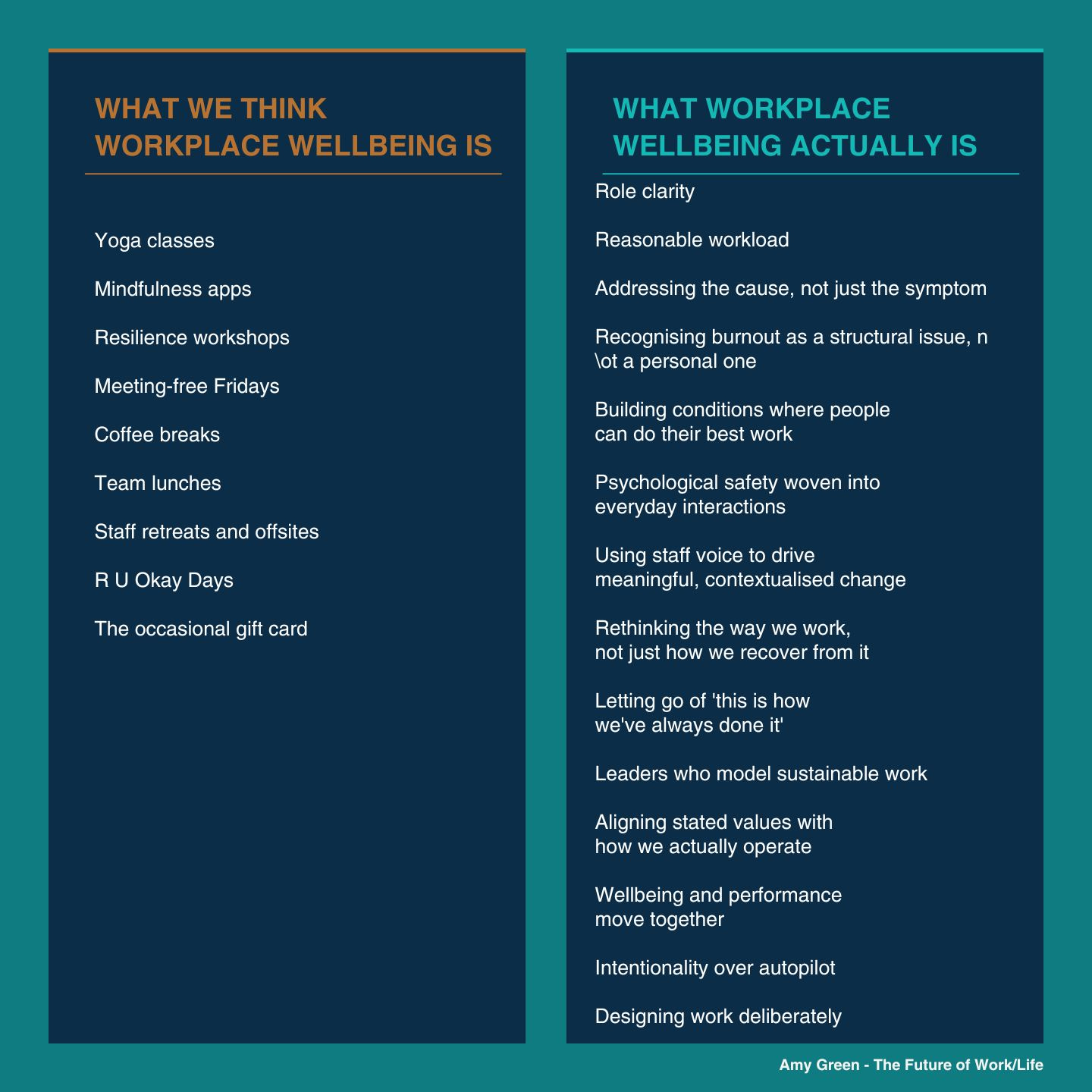
Here at Mahi Hauora, we’ve often highlighted the importance of moving beyond the low-hanging fruit (and arguably performative) well-being approaches to tackling psychosocial hazards to support workers.
This concept is echoed by Amy Green, who put together this simple, but handy, figure:
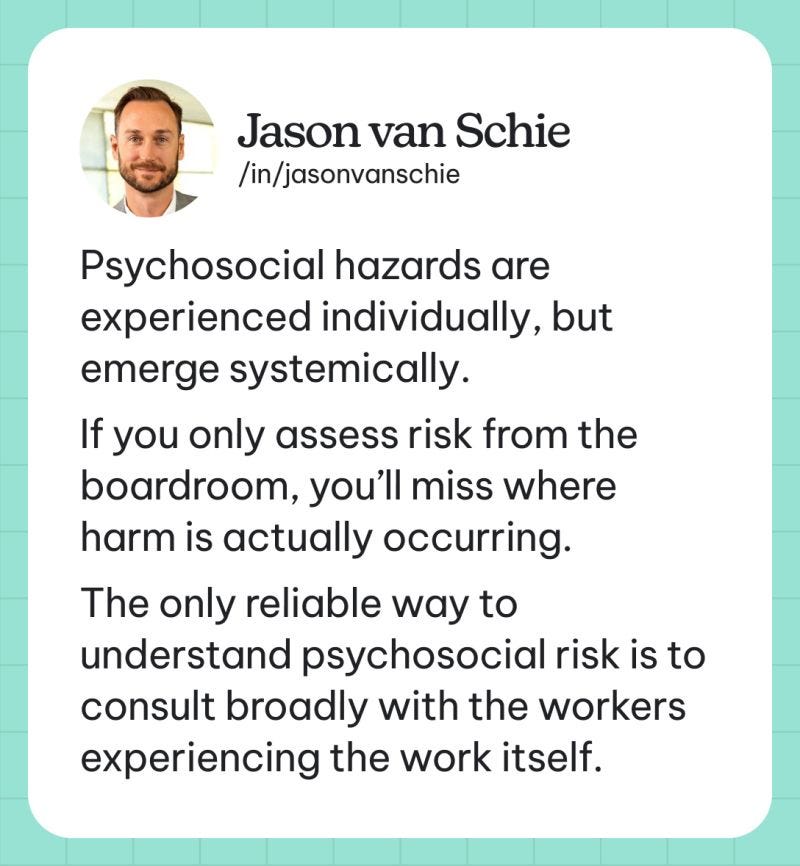
On LinkedIn, organisational psychologist and CEO of Flourish Dx, Jason van Schie, promotes the importance of deep consultation and engagement to support risk assessment.
Podcasts and interviews
Here are some podcasts/interviews I’ve heard (or been recommended) since the last newsletter:
Great Leaders Care with Graeme Cowan [Psych Health and Safety Podcast]
Flipping off Phones [the Galaxy Brain podcast]
What chance do we have versus the machines? [Eat, Sleep, Work, Repeat]
Why toughness and kindness need each other [The Curiosity Shop]
The safety rule most people are afraid to follow? [The Circus of Safety]
Research
Here are a few studies that have caught my eye since the last update.
Construction Health and Safety NZ, the NZ Scaffolding industry, and Scaffolding and Rigging New Zealand have collaborated on research looking at musculoskeletal disorders in the scaffolding sector. Analysing a decade of ACC claims data, the authors highlighted an increase in the number of days lost to shoulder and neck injuries (accounting for more than 12,645 days in 2025) via two main ‘damage mechanisms’. The research also identifies three ‘priority actions’ the authors argue need to be taken to address the issue.
A 2025 doctoral thesis from the US’ Walden University looked at the strategies used to mitigate the harm caused by toxic leadership and improve staff retention in the technology sector. The qualitative analysis re-affirmed the harm caused by toxic leadership behaviours (e.g., reducing job satisfaction and workers’ well-being), and underscored the importance of a co-ordinated approach comprised of multiple approaches (e.g., combining regular monitoring of psychological safety, strengthening bottom-up engagement, and embedding a servant leadership approach).
Australia’s Diversity Council released research looking at classism and bias at work. Their research presents “a strong case for creating class-diverse and inclusive workplaces”, which highlights the harm caused by workers’ exposure to classism and bias.
The Council also provides a set of supporting resources, including strategies for addressing this issue in the workplace.
US researchers have undertaken a comprehensive review of studies looking at the link between personality and cognitive ability.
From a workplace health and safety perspective, the meta-analysis highlights the effects of elements of psychosocial health and well-being (i.e., poor mental health, kindness and compassion) on cognitive functioning. The findings have implications for how information from personality and IQ/cognition assessments is used to tailor interventions at work.
Organisational psychology professor Arnold Bakker has provided a brief review of ‘the burnout paradox’. In this piece, Professor Bakker discusses the phenomenon of burnout - recognised as an occupational disease in some jurisdictions - and argues that “those who care the most often recover the least and, in doing so, undermine both their well-being and the quality of care they deliver.”13
A group of Australian researchers have taken a look at the factors that affect implementation of culture change programs in the healthcare sector. The authors undertook a scoping review, screening nearly 8,000 studies and eventually including 17. From this mahi, they identified 10 key factors influencing these programs, such as training, measurement, leadership, provision of resources, and stakeholder engagement.
If you’ve encountered research you’d like to share with other readers, please add details in the comments!
Events
There’s a range of upcoming events you might be interested in exploring…
June
17 - Creating Cultures of Respect [Te Uru Tāngata], 9.30-11.30am, online.
17 - Beyond Yoga and Fruit Bowls: What Well-being Looks Like in Practice, [NZISM], 10.30-11.30am, online.
18 - ISO 45003: Applying the Standard in Practice [HeartBrain Works], 2.00-3.00pm, online.
21 - ShopCare National Workplace Customer Aggression survey closes
23 - New Zealand Workplace Health and Safety Awards 2026: Gala Dinner and Awards [Safeguard], Viaduct Events Centre, Auckland.
23-24 - Safeguard Conference 2026 [Safeguard], Viaduct Events Centre, Auckland.
24 - Re-thinking Job Design for Fairness [Te Uru Tāngata], 2.00-3.00pm, online.
30 - Psychological Health and Safety for Small Business [SafeWork NSW], 10.00-11.00am [AEST], online.
July
15 - North Queensland Work Well Conference [WorkSafe Queensland], 8.30am-4.30pm, Ville Resort Casino, Townsville, QLD.
27 - SafetyTech Roadshow [NZISM], 8.00am-4.30pm, Novotel, Christchurch Airport, Christchurch.
28 - Influencing Senior Leaders for Safer, Healthier Work [HeartBrain Works], 2.30-3.30pm, online.
29 - HSR Development Day [ShopCare], 9.00am-4.00pm, Te Manawa NorthWest, 11 Kohuhu Lane, Westgate, Auckland.
29 - SafetyTech Roadshow [NZISM], 8.00am-4.30pm, Cliftons (The Majestic Centre), Wellington.
30 - Words that Work: Using SMART Language for Better Work Design Conversations [Comcare, Australia], 2.00-2.45pm (AEST), online.
31 - SafetyTech Roadshow [NZISM], 8.00am-4.30pm, The Maritime Room, Princess Wharf, Auckland.
August
4 - SafetyTech Roadshow [NZISM], 1.30-4.00pm, online.
6 - SafetyTech Roadshow [NZISM], 1.30-4.00pm, online.
25 - SafeSkills H&S Rep Conference Roadshow [Safeguard], Eden Park, Auckland
26 - SafeSkills H&S Rep Conference Roadshow [Safeguard], FMG Stadium, Hamilton
27 - SafeSkills H&S Rep Conference Roadshow [Safeguard], Trinity Wharf, Tauranga
September
2 - SafeSkills H&S Rep Conference Roadshow [Safeguard], Christchurch Town Hall, Christchurch
3 - SafeSkills H&S Rep Conference Roadshow [Safeguard], Hnry Stadium, Wellington
8-9 - PHSCON (Psych Health and Safety Conference) 2026 [Flourish Dx], Hyatt Regency, Sydney.
9 - ePIC 2026: Safety, Rewired - Transforming H&S Through Care, Leadership, and Technology [ecoPortal], 8.30am-4.30pm, NZICC, Auckland.
I undertake this mahi in my own time and at my own expense and my goal is to keep it free and open access for as long as possible. I would greatly appreciate it if you can share this resource among your professional networks, encourage those you know to subscribe, and like and comment on posts.
Thanks very much for checking out this month’s newsletter. Remember, if you have suggestions for content this year - or any other feedback, please get in touch. You can find me on LinkedIn or you can add a comment to this post.
Be well, be safe, and take care!
Noho ora mai,
Matt
Wallendfeldt, J. (2025, 13 June). Why is Pride Month celebrated in June?
The Happiness Index (2026, p.7). Global Happiness Report 2026.
Education and Workforce Select Committee (2026, March; p.15).
ibid
ibid, p.17
ibid
United Nations University (2026, 3 June). The Environmental Cost of AI [website].
IPSOS (2026; p.2). The IPSOS AI Monitor 2026.
IOSH (2026; p.2). The Digital Dilemma.
Te Whatu Ora (2026, 11 June). Business Mental Health Toolkit.
PSLI (2026, 26 May). The Accidental Manager.
Bakker, A. (2026, June; p.166). “The Burnout Paradox”. World Psychiatry, 252, pp.166-167.